 Posted by
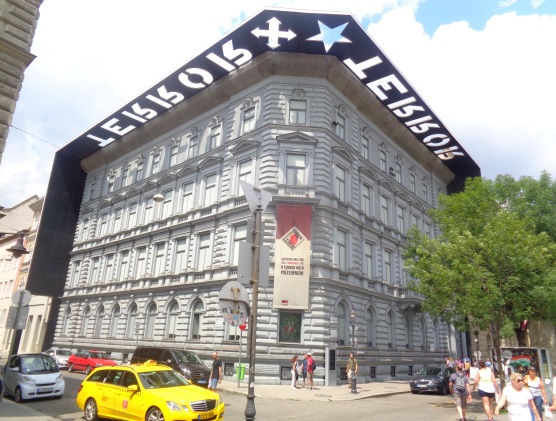
The House of Terror Museum on Andrássy Avenue examines Hungary under two twentieth-century dictatorships. Its setting is integral to the story: the building at number 60 was used by the Arrow Cross and later by the communist political police. A visit can be emotionally demanding. Allow enough time to understand the exhibits, rather than adding it as a brief stop between lighter attractions.
At a glance
- Address: Andrássy út 60, Budapest.
- Focus: Political terror under the Arrow Cross and the communist regime, and the experience of victims.
- Allow: Roughly two hours, more if you use an audio guide or read extensive material.
- Before going: Check the official visitor page for current opening and admission. Photography is restricted inside.
What is the House of Terror?
The museum occupies a building that became associated with political violence in two different periods. Hungary’s fascist Arrow Cross movement used it during the final phase of the Second World War; subsequently, communist security organizations operated there. The museum presents documents, objects, film, reconstructions and accounts of persecution. The historical periods are related by place, but they should not be collapsed into one simple narrative. Their ideologies, wartime contexts and victims need to be understood on their own terms.
Its design is deliberately theatrical. Sound, lighting and staged rooms can make an impression even before you have read the accompanying explanations. Some visitors find this powerful; others prefer a more conventional documentary museum. Going in with that expectation helps you engage critically: distinguish an original artifact, a reconstruction and a museum interpretation. An audio guide or advance reading may add context, especially if you do not speak Hungarian.
How to approach the exhibition
Begin with the timeline of Hungary in the 1940s and after the war. Understanding the German occupation, the Holocaust in Hungary, the end of the war and the establishment of communist rule makes individual rooms much easier to follow. The displays deal with surveillance, imprisonment, forced labour, propaganda and resistance. The basement cells are often among the most affecting spaces. Give yourself permission to take a break if needed.
The building itself can be a historical source, but remember that museums make editorial choices. An exhibition does not replace broader reading about Hungary’s Jews, the wartime state, Soviet influence or the 1956 revolution. Nearby sites provide other perspectives: the Dohány Street Synagogue and the Shoes on the Danube Bank are important for Holocaust remembrance. Visit them respectfully and avoid treating distinct histories as interchangeable.
Practical visitor information
The official museum information gives the current hours, admission and any temporary closures. Check it shortly before departure: a museum schedule can change for technical reasons or events. If a guide or audio guide matters to you, verify its language and extra charge before arriving. Large groups should consult the booking rules. The museum’s visitor rules restrict photography and video in the exhibition, with an exception noted for the tank on the ground floor.
Security and visitor flow may add time on busy days. A small bag and comfortable shoes make the route easier. Exhibits include difficult material and may not suit every child; parents can decide whether this is an appropriate visit for their family. Avoid rushing through at the end of a long sightseeing day, when concentration is harder.
Where it is and how to get there
Andrássy Avenue connects central Pest with Heroes’ Square. The House of Terror stands near Vörösmarty utca station on the M1 underground. That line also serves stops toward City Park. Tram 4/6 stops at Oktogon, from where it is a short walk. Check our metro and public transport guides for ticketing and connections.
The avenue is worth noticing before or after the museum: its architecture reflects Budapest’s growth in the late nineteenth century. You could continue to Heroes’ Square, but leave time between a difficult exhibition and another activity. A café break or a quiet walk may be more appropriate than an overpacked itinerary.
Planning a history-focused day
If twentieth-century history is the main purpose of your trip, choose two substantial sites rather than four quick ones. You might visit the House of Terror in the morning and walk by the Danube later, or see the synagogue complex on a separate day. Our guides to Parliament, Buda Castle and Budapest sights can help build a balanced itinerary.
The museum is also a prompt to learn beyond one institution. Hungary’s twentieth-century history cannot be contained in a single address. Consult museum materials, historical scholarship and the accounts of different communities if you want to understand how occupation, dictatorship and resistance affected lives across the country.
Staying near an M1 or central tram stop makes the museum and other historical sites straightforward to reach. Compare locations before choosing a room.
A carefully chosen history walk can complement the museum. Read the guide’s itinerary and historical focus before booking; it is a separate experience, not museum admission.
Before you enter
A little background helps. Hungary experienced German occupation in 1944, the murder and deportation of much of its Jewish population, and the violence of the Arrow Cross movement. After the war, the country entered a Soviet-dominated political order, and a communist dictatorship consolidated power. The building at Andrássy út 60 links these periods through successive political organizations, but the people and events were not the same. Read a basic chronology before visiting if these chapters are unfamiliar.
Because exhibition design is intense, it can be easy to remember an image more strongly than an explanation. Pause at the labels and ask what a room is documenting. Is it the history of this address, a broader national event or a reconstruction meant to evoke an experience? That habit makes the visit more informative and more respectful to the people whose lives it presents.
Languages and interpretation
Check what interpretation is available in your preferred language. A written translation, audio guide and guided tour are different ways of engaging with the exhibition. If an audio guide is offered, allow extra time to use it fully. Visitors who cannot access a particular language may still find the displays powerful, but the historical argument can be harder to follow without context.
Consider reading material from other institutions afterward, especially on the Holocaust in Hungary and on communist rule. Historical interpretation is an ongoing discussion. The museum offers a distinct perspective within that discussion, and a visitor benefits from understanding both the events and how they are presented.
Respectful pacing
There may be queues at the entrance and groups moving through narrow spaces. Let people read in their own time and avoid speaking loudly in areas devoted to victims. If a room is distressing, it is reasonable to step away. Do not plan to use the visit as a quick photo opportunity: interior photography is restricted, and the most valuable part is the careful encounter with historical evidence.
Outside, Andrássy Avenue can feel ordinary again. That contrast is part of the experience. Give yourself a short break before continuing with other sightseeing, and discuss what you learned without turning the visit into an attraction rating.
Frequently asked questions
Is the museum inside the original building?
Yes. The address itself is part of the history. The exhibition includes constructed displays as well as historical material, so read the labels carefully.
Can I take photographs?
The museum’s rules prohibit photography and video in most exhibition areas. Check the current rules for the stated exception and follow staff directions.
Is an audio guide worthwhile?
It can help visitors follow the historical narrative and room sequence, especially when language is a barrier. Check availability, language and cost on the official site.
Should I bring children?
That depends on their age and readiness for accounts of political persecution. Review the museum’s subject matter beforehand and plan breaks if visiting as a family.