 Posted by
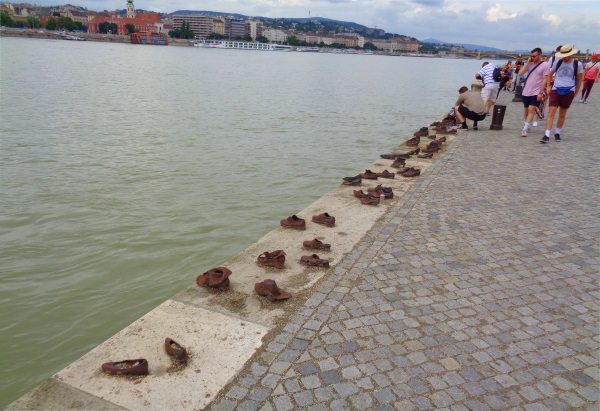
Shoes on the Danube Bank is a Holocaust memorial on the Pest bank of the river, a short walk south of the Hungarian Parliament. Sixty pairs of iron shoes recall people murdered along Budapest’s Danube during the Arrow Cross terror in 1944 and 1945. There is no ticket and no guided route required to see it. A visit is best made with time to understand the history and a willingness to treat the place as a site of remembrance, not merely as a stop for photographs.
At a glance: Shoes on the Danube Bank
- Hungarian name: Cipők a Duna-parton.
- Location: Pest riverbank near the Parliament.
- Created: 2005 by Can Togay and Gyula Pauer.
- Form: 60 pairs of cast-iron shoes, including men’s, women’s and children’s footwear.
- Admission: free, outdoors and accessible at any hour subject to riverfront restrictions.
- Allow: enough time to read the context and reflect; this is a memorial, not an entertainment venue.
What does the memorial commemorate?
The shoes honour victims, particularly Jewish people, who were killed in Budapest during the final months of the Second World War. Members of the fascist Arrow Cross movement murdered people at several points along the Danube. The work evokes the belongings left behind and the absence of their owners. It does not mark a single precise execution site for every victim. That distinction matters because the crimes occurred along more than one stretch of riverbank.
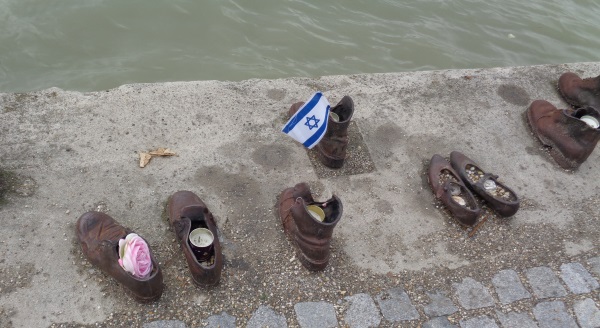
Different sizes and styles of shoes stand in rows at the edge of the embankment. Some visitors leave flowers, candles or stones. The effect is direct without a large statue or an enclosed museum. There are no actors or staged scenes; the place relies on the visitor bringing historical understanding. The city’s official tourism description identifies the 60 pairs and the creators.
It is easy to arrive during a busy sightseeing day and leave after a minute. A slower visit gives the setting meaning: the river is central to the city’s beauty and also to this history of violence. If you are travelling with children, explain the subject in an age-appropriate way before reaching the site.
The historical context
Hungary and the German occupation
Hungary was allied with Nazi Germany and introduced antisemitic laws before German forces occupied the country in March 1944. The occupation accelerated persecution and deportations. Hungarian authorities participated in the deportation of Jewish people from the provinces, and large numbers were murdered after being sent to Auschwitz-Birkenau. The history cannot be reduced to a claim that “transport to camps became difficult, so people were killed locally”; both deportation and murder in Budapest were products of decisions by perpetrators and their collaborators.
The United States Holocaust Memorial Museum’s history of Hungary provides a broader account. It is a better basis for understanding the period than an isolated tourist plaque or a simplistic explanation. Budapest’s Jewish community was large before the war, and its members faced escalating restrictions, forced labour, deportation and violence.
Arrow Cross rule in Budapest
In October 1944 the Arrow Cross came to power with German support. Its militia terrorised the city’s Jews and other targeted people. Murder at the riverbank became one of the most notorious crimes of that period. The Holocaust Museum’s Budapest account describes the coup, persecution and attempts at rescue, including the work of diplomats such as Raoul Wallenberg.
There are limits to what can be learned from a monument alone. The shoes do not give individual biographies for all those who died, nor should the count of sculptures be confused with the number of victims. Sixty pairs form an artistic representation. To learn more about the people and the mechanisms of persecution, pair a memorial visit with reliable historical reading or a thoughtfully conducted museum visit.
Why shoes?
The footwear represents ordinary people and the possessions left at the water’s edge. Men’s, women’s and children’s designs stress that victims were individuals of different ages and lives, rather than an anonymous statistic. The memorial’s simplicity also makes the absence palpable. It does not need a large explanatory installation to convey loss, but understanding the Arrow Cross context prevents the image from becoming detached from its history.
Who created the memorial?
Film director Can Togay and sculptor Gyula Pauer created the work, unveiled in 2005. The iron shoes evoke styles from the period. Older accounts sometimes describe them simply as “about sixty” or as a collection of adult shoes; the city’s tourism information specifies sixty pairs representing men, women and children. The Hungarian name, Cipők a Duna-parton, translates as “Shoes on the Danube Bank”.
The memorial belongs to the river landscape but is not a decorative part of it. Tourists may be photographing the Parliament or the Buda skyline nearby; here the purpose is different. The public nature of the site means visitors arrive at all hours and with varied levels of knowledge. A short explanation read beforehand can make the experience more meaningful.
Where exactly is it?
The memorial is on the Pest bank of the Danube just south of the Hungarian Parliament. Look for the lower riverfront promenade rather than the Parliament’s main entrance. The nearest practical approach depends on your transport stop and any temporary embankment works. Use a map to find the memorial name and a safe public path; do not climb over barriers to reach the water.
M2 Kossuth Lajos tér is a useful metro stop for the Parliament area. Tram 2 runs along parts of the Pest riverfront and can be another approach depending on service. The metro guide and public transport guide explain tickets and current planning tools. The final few minutes are on foot, potentially via steps or sloped paths, so visitors who need step-free access should check the exact route.
The riverbank can be windy, wet or affected by high water. Budapest tourism and transport authorities issue temporary notices when the Danube rises. If the lower embankment is closed, do not bypass the closure. You can return another day or learn about the memorial from official historical sources.
How to visit respectfully
Keep voices low, leave room for others and avoid climbing or sitting on the shoes. Do not move flowers, stones or memorial items for a photograph. A picture can be appropriate as a personal record, but posing playfully among the footwear is inconsistent with the purpose of the site. If a group is present for remembrance, allow it space.
Read the historical information before or after the visit. A guided historical walk may offer context, but evaluate whether the guide treats the subject seriously and provides accurate sources. Avoid combining a visit with a sales pitch or entertainment activity at the memorial itself. On this page, practical travel suggestions are kept away from the central account of the victims.
Children may ask why shoes are empty. A simple explanation can identify that people were murdered because they were Jewish under a racist and antisemitic regime, while leaving more graphic details for an appropriate age. Do not describe the memorial as a harmless art installation if the child is old enough to understand its purpose.
Nearby places for historical context
The Parliament is close enough to combine geographically, but the memorial deserves its own moment. Farther into the city, the Dohány Street Synagogue and Jewish heritage sites provide further context, though they tell different parts of a long history that extends well beyond the Holocaust. The House of Terror addresses twentieth-century dictatorships from its own curatorial perspective. Check opening hours and exhibitions rather than assuming all can be fitted into a hurried afternoon.
For a wider riverfront walk, the Chain Bridge lies to the south and Margaret Bridge to the north. The Danube bridges guide gives orientation, but the bridge walk is a separate sightseeing activity. Leaving the memorial for an ordinary city route is natural; treating the memorial itself as a scenic backdrop is not.
A short, thoughtful route
Start near Kossuth Lajos tér, view the Parliament exterior and then walk to the riverbank memorial. Pause without a strict timetable. Continue south along the public promenade if it is open, or return to the square. This route is straightforward on a map, but street crossings and embankment access can change. Use signs and current conditions rather than trying to follow a rigid turn-by-turn instruction from years ago.
If you have more time, visit a museum or Jewish heritage site on another part of the day. A single memorial cannot tell the entire story of Hungarian Jewish life, persecution, resistance and survival. Reliable historical resources from the USHMM are useful before a visit.
Understanding the wider history
The riverbank killings were one part of the Holocaust in Hungary, not its beginning or its only form. Antisemitic laws had excluded Jewish people from public life and livelihoods before 1944. After the German occupation, deportations from outside Budapest proceeded rapidly with Hungarian participation. Budapest’s Jewish residents faced forced relocation, violence and the threat of deportation. Some found temporary protection in buildings associated with foreign diplomatic missions, while others were forced into labour or confined in the ghetto.
When the Arrow Cross took power, the danger in the capital intensified. Armed groups attacked people in streets and homes and carried out shootings at the Danube. Individual victims’ stories cannot be recovered from the shoes alone. The memorial asks viewers to imagine lives interrupted while leaving space for historians, survivors and families to tell those stories in fuller detail. The scale of violence in Hungary and the different roles of German and Hungarian perpetrators are documented by Holocaust research institutions.
There were also efforts to help people escape or survive. Foreign diplomats and local helpers issued protective documents, sheltered people and intervened where they could. These actions mattered enormously to those saved, but they did not erase the crimes or the losses. A thoughtful itinerary might include Jewish cultural history from before the war and accounts of survival after it, rather than treating Jewish Budapest only as a history of victimhood.
What the memorial can and cannot explain
A public artwork can make a historical fact visible in a busy city, but it cannot replace an archive, a museum or testimony. The shoes identify no single victim by name; the riverbank itself offers little explanation of the political events that led to the murders. That is why a visitor benefits from reading a trustworthy historical account alongside seeing the work. It also helps avoid a common misunderstanding that the exact place of every pair of shoes corresponds to an individual documented shooting.
The city has changed greatly since 1945. Buildings, traffic and tourist routes now surround the site. The memorial’s position in everyday public space means remembrance is encountered by people who may not have planned a museum visit. Respectful behaviour preserves that function for local residents, descendants and visitors alike. If you want to leave a tribute, follow the site’s established practice without disturbing what others have placed there.
Frequently asked questions
Is there an entrance fee?
No. It is an outdoor public memorial. Temporary riverfront restrictions can affect access.
How many shoes are there?
Sixty pairs of cast-iron shoes, including designs for children and adults. They symbolise victims; the number is not a count of everyone murdered along the Danube.
Who committed the murders?
Members of Hungary’s fascist Arrow Cross movement murdered Jewish people and others in Budapest during 1944–45. The broader Holocaust in Hungary involved Nazi Germany and Hungarian authorities and collaborators.
Is this the exact site of every shooting?
No. Killings occurred at different riverbank locations. The memorial stands as a public place of remembrance for victims rather than a marker for each individual crime scene.
How much time should I allow?
The physical site is small. The time you spend depends on reading and reflection; it is better to leave a little flexibility than to treat the memorial as a one-minute photo stop.